


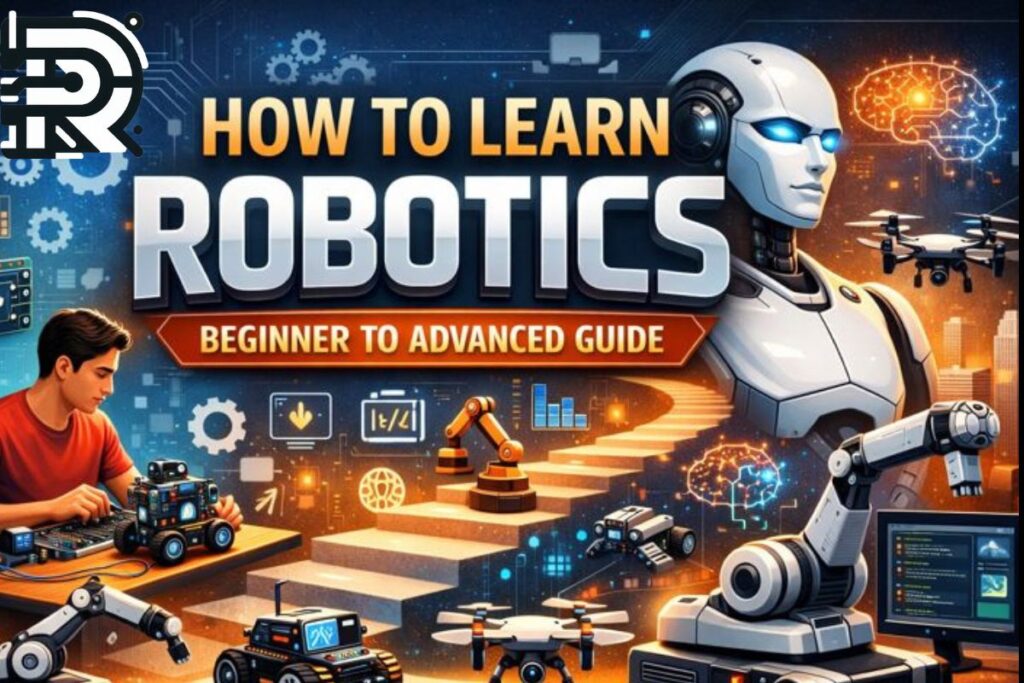
Learning robotics is a gradual journey from curiosity to capability.
Robotics is not a single skill that can be mastered overnight. It is a structured learning process that blends mechanics, electronics, programming, and intelligent decision-making. When learned step by step, robotics becomes logical, practical, and deeply satisfying. This guide explains how anyone can learn robotics from the beginner level to advanced applications with clarity and confidence.
What Is Robotics?
Robotics is a multidisciplinary field that focuses on designing, building, and programming machines capable of performing tasks autonomously or semi-autonomously. These machines, known as robots, can sense their environment, process information, and act based on predefined or learned logic.
In simple terms, robotics is about teaching machines how to observe, decide, and act.
For example, when a robot detects an obstacle using a sensor, processes that information through code, and then changes direction using motors, all these actions together form a robotic system.
Why Learning Robotics Matters Today
Robotics is rapidly transforming industries across the world. Manufacturing, healthcare, agriculture, logistics, defense, and space exploration all rely heavily on robotic systems. Even daily-life products such as smart vacuum cleaners, automated doors, and delivery drones are based on robotics principles.
Learning robotics today means preparing yourself for future technologies that will dominate the global economy.
Who Can Learn Robotics?
Robotics is not restricted by age, academic background, or profession. Anyone with curiosity and discipline can learn robotics.
It is suitable for:
- School and college students
- Engineering aspirants
- Hobbyists and DIY learners
- Entrepreneurs and startup founders
- Professionals seeking future-ready skills
You do not need advanced knowledge at the beginning. Robotics rewards learners who progress steadily.
Skills Required for Robotics
Many beginners assume robotics requires expert-level mathematics or advanced coding from day one. This is not true.
Robotics skills develop gradually and include:
- Logical thinking
- Basic mathematics and physics understanding
- Curiosity to experiment
- Problem-solving ability
- Patience and consistency
Robotics is less about memorization and more about understanding how systems interact.
Robotics Learning Roadmap
A structured roadmap is essential to avoid confusion.
Robotics learning can be divided into five clear stages:
- Fundamentals of robotics
- Electronics and hardware basics
- Programming and control logic
- Robot building and mechanical design
- Advanced robotics and intelligence
Each stage builds a foundation for the next.
Stage 1: Robotics Fundamentals
Before working with hardware or code, it is important to understand basic robotics concepts.
Key topics include:
- Definition of a robot
- Difference between machines and robots
- Types of robots
- Sensors and actuators
- Feedback and control systems
This stage focuses on conceptual clarity rather than construction.
Stage 2: Basic Electronics
Electronics forms the backbone of all robotic systems.
You should begin by learning:
- Voltage, current, and resistance
- Ohm’s Law
- AC and DC concepts
- Series and parallel circuits
After fundamentals, move to components such as resistors, capacitors, LEDs, diodes, transistors, motors, motor drivers, and batteries.
Understanding electronics ensures safe and reliable robot design.
Stage 3: Microcontrollers
Microcontrollers act as the brain of a robot.
Beginner-friendly options include Arduino and ESP-based boards.
At this stage, you learn:
- Digital and analog inputs
- Motor and actuator control
- Sensor data processing
- Timing and delays
- Basic communication protocols
This is the stage where code begins to control real-world hardware.
Stage 4: Programming for Robotics
Robotics programming focuses on logic rather than complexity.
Essential concepts include:
- Variables and data types
- Conditional statements
- Loops and repetition
- Functions and modular code
- Timing-based decision-making
Programming teaches robots how to respond intelligently to sensor inputs.
Stage 5: Sensors and Environment Interaction
Sensors allow robots to understand their surroundings.
Common sensors include:
- Distance sensors
- Line-following sensors
- Light sensors
- Temperature sensors
- Motion sensors
This stage introduces calibration, noise handling, and real-world uncertainty, which are critical robotics skills.
Stage 6: Building Robot Projects
This stage combines electronics, programming, and mechanics.
Beginner projects include:
- Obstacle-avoiding robots
- Line-following robots
- Remote-controlled robots
- Simple automation systems
Completing projects builds confidence and practical understanding.
Stage 7: Mechanical Design Basics
Robots must be mechanically stable to perform accurately.
Important concepts include:
- Torque and speed balance
- Wheel and gear selection
- Weight distribution
- Chassis design
- Structural stability
Strong mechanics improve performance and reliability.
Stage 8: Control Systems
Control systems enable smooth and accurate robot movement.
Key topics include:
- Open-loop and closed-loop control
- Feedback systems
- PID control basics
- Stability and response tuning
This stage is essential for advanced robots such as drones and robotic arms.
Stage 9: Advanced Robotics and ROS
Professional robotics often uses the Robotics Operating System (ROS).
ROS enables:
- Modular software architecture
- Sensor fusion
- Navigation and mapping
- Simulation-based testing
This stage requires programming confidence and Linux familiarity.
Stage 10: Vision and Artificial Intelligence
Advanced robots use vision and intelligence to make decisions.
This includes:
- Image processing
- Object detection
- Visual tracking
- Intelligent decision-making
This stage represents the highest level of robotics learning.
Common Mistakes to Avoid
Beginners often fail by:
- Jumping to AI too early
- Skipping fundamentals
- Copying code without understanding
- Ignoring debugging
- Rushing the learning process
Robotics rewards patience and structured learning.
How Long Does It Take to Learn Robotics?
Approximate timelines:
- Fundamentals: 1–2 months
- Electronics and microcontrollers: 3–4 months
- Projects and mechanics: 6 months
- Advanced robotics: 1–2 years
Consistency matters more than speed.
Career Opportunities in Robotics
Robotics skills open doors in:
- Automation and manufacturing
- Healthcare and medical devices
- Defense and aerospace
- Agriculture and logistics
- Artificial intelligence industries
Demand for robotics professionals is growing globally.
Final Thoughts
Robotics is learned by building, testing, failing, and improving.
With a structured roadmap and consistent practice, robotics becomes one of the most powerful and future-proof skills you can acquire.
RELATED POSTS
View all


Why You Feel Tired Trying to Impress Everyone — And How to Build Real Self-Worth (Step by Step)
December 1, 2025 | by vikas