




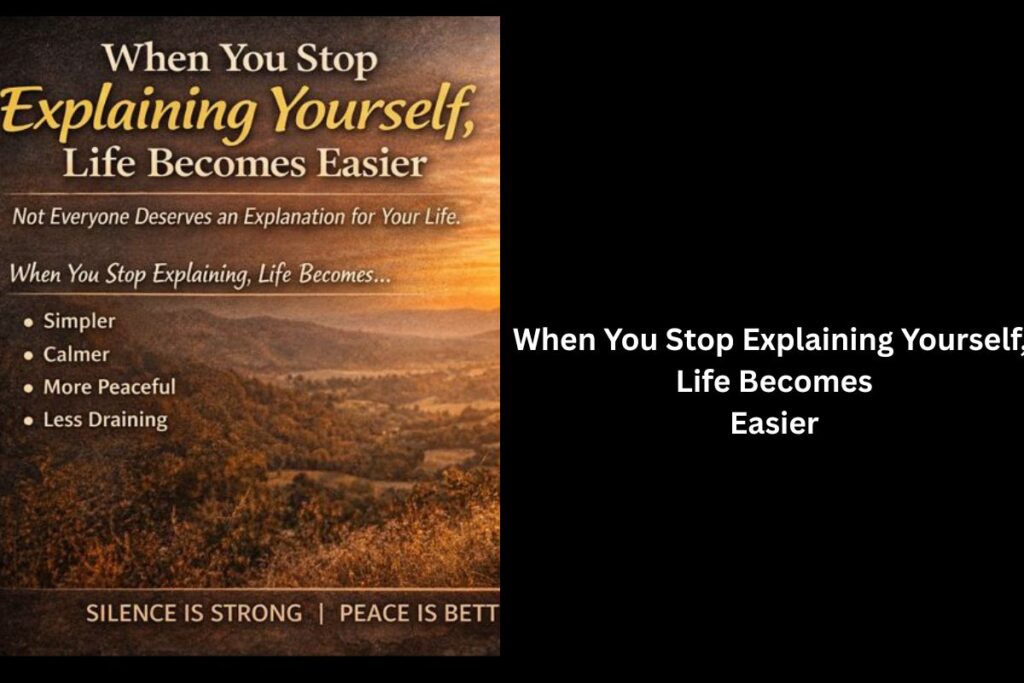
When You Stop Explaining Yourself, Life Becomes Easier is not about becoming careless or rude. It is about realizing that not everyone deserves access to your reasons, your energy, or your inner world. This blog is for those who are tired of justifying their choices to people who never truly listen.
Introduction: The Exhaustion of Always Explaining
At some point in life, you notice a strange kind of tiredness.
Not physical.
Not mental.
Emotional.
You are exhausted from explaining why you feel the way you feel.
Why you chose a different path.
Why you said no.
Why you changed.
And slowly, a realization settles in:
Some people don’t want to understand you.
They just want to question you.
That is where freedom begins—when you stop explaining yourself.
Why We Feel the Need to Explain Ourselves
From childhood, we are taught to justify everything:
- Our decisions
- Our emotions
- Our boundaries
We grow up believing that being understood by everyone is necessary.
But the truth is simple and uncomfortable:
People will interpret you based on their mindset, not your explanation.
You can explain yourself perfectly, and still be misunderstood.
Over-Explaining Is a Form of Self-Doubt
When you over-explain, you are unconsciously saying:
- “Please approve of my choice”
- “Please don’t judge me”
- “Please validate me”
Over time, this habit weakens self-trust.
People who trust themselves:
- Speak less
- Explain less
- Stand firm without noise
Confidence does not shout.
It does not argue.
It does not beg to be understood.
Not Everyone Deserves an Explanation
This is one of the hardest truths to accept.
You do not owe an explanation to:
- People who disrespect you
- People who gossip about you
- People who never supported you
- People who benefit from your confusion
Your silence is sometimes your boundary.
And boundaries do not need explanations.
What Happens When You Stop Explaining
At first, it feels uncomfortable.
People may:
- Question you more
- Call you rude
- Say you have “changed”
But something powerful happens inside you.
You begin to feel:
- Lighter
- Calmer
- More grounded
You stop trying to control how others see you.
You start protecting how you feel.
Silence as Strength
Silence is often misunderstood as weakness.
In reality, silence is clarity.
When you stop explaining:
- Your actions speak
- Your boundaries become visible
- Your energy is preserved
Silence filters people.
Those who respect you stay.
Those who don’t slowly disappear.
Relationships Improve—or End
When you stop explaining yourself in relationships:
- Healthy relationships grow stronger
- Unhealthy ones collapse
And that is not a loss.
Because relationships that survive only on your emotional labor were never balanced to begin with.
Real connection does not demand constant justification.
How to Practice This in Daily Life
1. Answer Only Once
You don’t need to repeat yourself to be respected.
2. Say Less, Mean More
Clear words. Calm tone. No drama.
3. Let Actions Speak
Consistency explains more than arguments.
4. Accept Being Misunderstood
Peace is better than approval.
5. Trust Yourself
If it feels right to you, that is enough.
The Quiet Freedom That Follows
One day, you’ll notice:
- You don’t rush to reply
- You don’t panic over opinions
- You don’t feel guilty for choosing yourself
Life becomes simpler—not because problems disappear,
but because you stop carrying unnecessary emotional weight.
Final Thoughts: Choose Peace Over Proof
You do not need to prove your pain.
You do not need to justify your growth.
You do not need permission to change.
Sometimes the most powerful sentence is:
“I don’t need to explain myself anymore.”
And in that moment, life truly becomes easier.
अगर चा
RELATED POSTS
View all






Important dating rules that every woman should know for a healthy love life
November 17, 2024 | by vikas